

Can milk really help snake plant grow and thrive? Perhaps. But there is a trick to it, and we are here to share that with your snake plant.
Snake plants are among the easiest indoor plants to care for because they are tolerant of low light, irregular watering, and minimal fertilizing. Now, because they’re so hardy, many plant lovers look for natural ways to boost their growth or appearance. One idea is using milk on snake plants. But is this actually beneficial, or not, is for us to find out!
Can Milk Benefit Snake Plants?

Milk contains nutrients such as calcium, potassium, magnesium, and micronutrients, many of which are also found in commercial plant fertilizers. These nutrients could help support structural growth, leaf strength, and internal balance. You must have come across how calcium helps the leaves stay firm.
However, it’s important to remember that snake plants absorb nutrients slowly, so any natural addition should always be mild and occasional rather than frequent.
Another notable thing is that snake plants are succulents adapted to thrive in nutrient-poor, well-draining soil. They do not require frequent or heavy fertilization, and their natural growth rate is slow. Most of the nutrition in milk is in the form of proteins or fats that the plant can’t directly absorb. When milk is added to the soil, its sugars and proteins can support bacteria and fungi rather than the soil’s health, leading to foul smell or root rot.
So, you cannot substitute milk for your fertilizers, but you use it occasionally and strategically, with either of the techniques below!
1. Soil Application
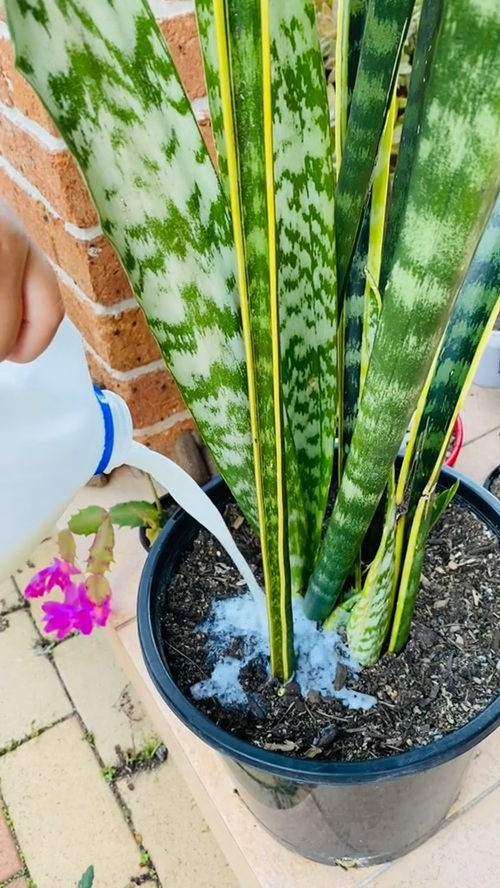
Use highly diluted milk, about one part milk to six or eight parts water, and pour a small amount around the soil surface, avoiding the leaf base. This will help in light nutrient supplement. Always test on one plant first before applying entirely, especially if your indoor space has high humidity.
2. Foliar Feeding
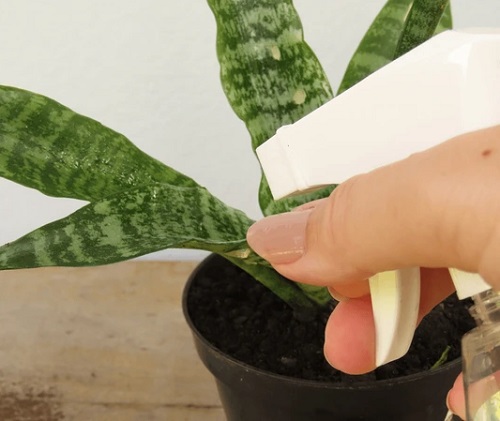
A very light mist with one part milk to nine-ten parts water can provide a gentle nutrient boost to leaves. Always mist in the morning so moisture dries quickly and prevents buildup.
3. Leaf Shine
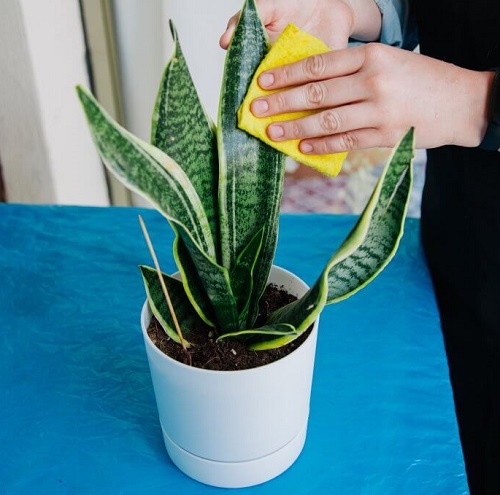
Dust and grime block sunlight and slow down the growth. A cloth lightly dampened with a tiny amount of diluted milk (about 1–2 teaspoons per cup of water) can clean leaves, followed by wiping with plain water to avoid residue.
4. Calcium Support

In homes with very soft water (low mineral content), highly diluted milk once every 6–8 weeks during active growth can provide minimal calcium and maintain leaf firmness. If your snake plant already grows in mineral-rich tap water conditions, you can skip this one.
5. Caution

Milk can also leave a residue on leaves or soil that attracts pests and interferes with gas exchange. Excess moisture from milk can soften soil and suffocate roots, a serious threat to succulents adapted to dry soils.
If you ever notice a sour smell, sticky leaves, or white film forming, stop using milk immediately and let the soil bathe lightly with plain water.
Otherwise, you can also use a well-draining cactus or succulent mix. But make sure to water only when the soil is dry, and provide bright, indirect light. Fertilize lightly with a balanced fertilizer in spring and summer.
So, you can use milk for your snake plants, but only when you have exercised caution and diluted it enough. Caring for snake plants is easy because they are low-maintenance, but only if you’ve got the master key to understand what they need. Let us know if this trick worked for you in the comments below!