
As an Amazon Associate, we earn a small commission from qualifying purchases — at no extra cost to you.
Can milk actually help your jade plants thrive? Learn the truth behind using milk as a fertilizer for your Crassula ovata.

Jade Plants are low-maintenance succulents that thrive with minimal care. Some say milk is beneficial for your plant, while others claim it can cause harm. But how do we know what our Jade loves? Let’s unpack what some people have said and understand if it is suitable for our jade plants or not.
Want to give your Jade Plant better care without relying on household remedies? Explore our Amazon Gardening Storefront for succulent fertilizers, fast-draining soil, moisture meters, pruning tools, spray bottles, pots, and other Jade Plant care essentials.
Milk for Your Jade Plants? Pass or Fail?
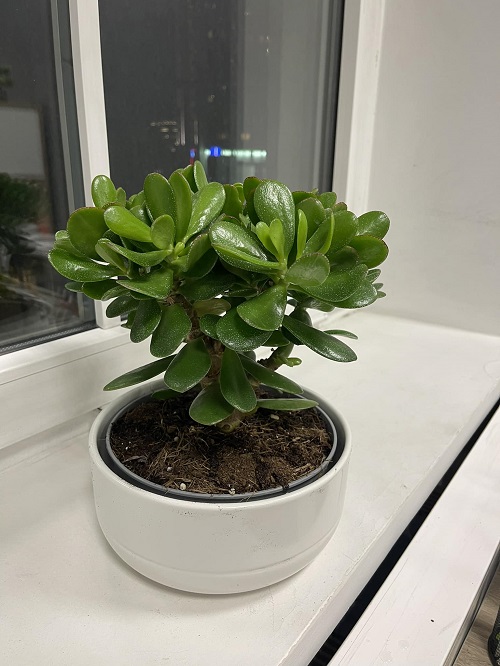
Hold on! Read this before you spill the leftover milk in your planter. Milk is nutritious and is said to act as a fertilizer, providing calcium, proteins, and sugars. Using it as a foliar feed and spraying it onto the leaves or as an anti-fungal remedy for powdery mildew can be beneficial.
Using a 50-50 mix of milk and water spray has been a successful experiment for most gardeners. Otherwise, you can also dilute milk to 20%–30% in water and apply every 1–2 weeks, which may help get rid of powdery mildew and improve leaf health. This provides a nutritional boost to your plants. Mix well and use a sufficient volume to reach the roots, similar to your regular watering amount.
Looking for a more reliable nutritional boost for your Jade Plant? A gentle succulent fertilizer is a better option than relying on milk and can provide nutrients without adding unnecessary organic residue to the soil.
A review by Washington State University found that milk sprays helped reduce fungal infections in some species and crops. Although they do not recommend using milk on a routine basis as a fertilizer, milk is also regarded as a cost-effective option compared to traditional fertilizers and compost because it contains only about 0.5% nitrogen.
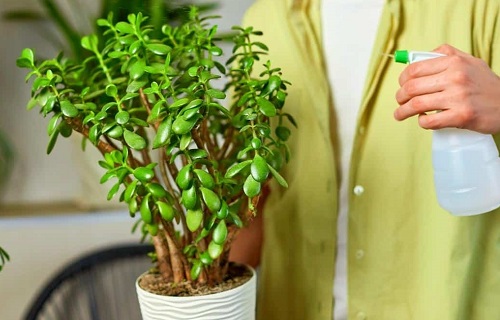
If you’re experimenting with a diluted foliar spray, use a clean fine-mist spray bottle to apply a light, even coating rather than soaking the leaves.
What To Do for your Jade Plants?
Succulents need low-nutrient, well-draining soil, infrequent watering, and minimal foliar sprays. Applying milk in excess, which contains sugars, fats, and high moisture, can hinder your jade plant’s healthy growth.
There can be a risk of rot or odor because, unlike others, jade plants are sensitive to moisture and organic deposits. As milk breaks down, it can create a foul smell and encourage microbial growth on leaves or in the soil. Milk is low in available nitrogen, phosphorus, and potassium; its fertilizer value is minimal.
Want to give your Jade Plant the conditions it actually needs? A fast-draining succulent soil mix can help reduce excess moisture around the roots and create a healthier growing environment.
Do Milk and Jade Plant Get Together?
Now, milk might be able to eliminate mildew issues for certain crops or plants, but it is not very relevant to jade plants and their concerns. It can be an alternative, but there are other options to consider for your jade plants as well. A light, succulent fertilizer is one of them.
But aren’t we all curious? If you want to experiment for yourself, start with a very diluted spray made with 1 part milk and 4–5 parts water, and apply only to the leaves. Take care of your jade plants like you generally do to encourage new growth, and watch for fungal infections, smell, or leaf damage at the same time.
Want to understand what your Jade Plant actually needs to thrive? A good succulent-care book can help you learn about watering, soil, light, fertilizing, pruning, propagation, and common problems so you can make better care decisions.
So, can you use milk for your jade plants? Yes, but only with great caution, because while it offers benefits, there are also considerations to keep an eye on. After you experiment and figure out if that worked well for your jade plant, do let us know in the comments below as well!